
In celebration of Women’s History Month, Steptoe & Johnson presents the sixth installment of our “Women Who Inspire” series, featuring female leaders who will share reflections on women empowerment, opportunities for professional women now and in the future, and the women they have looked up to throughout their careers.
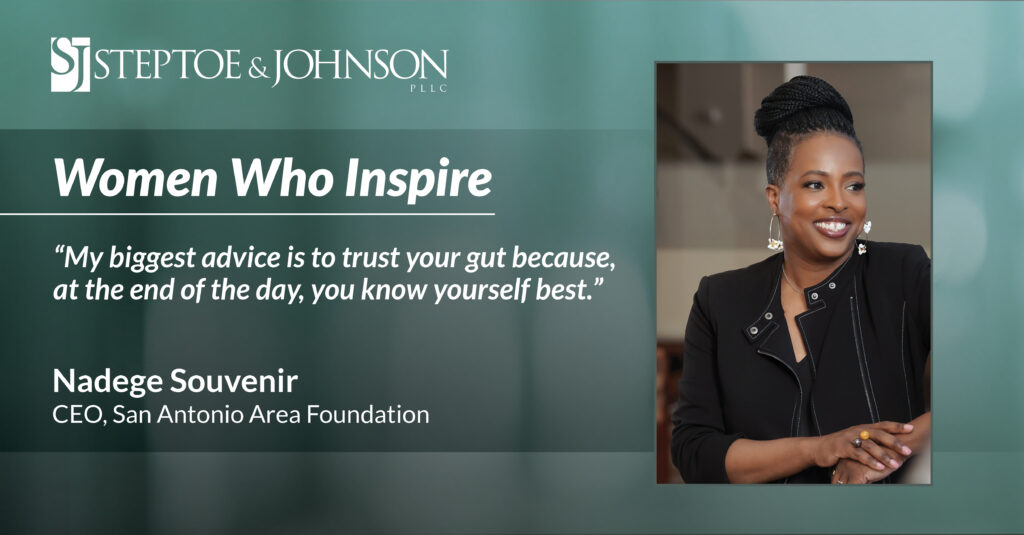
Nadege Souvenir is the CEO of the San Antonio Area Foundation where she leads an organization that stewards more than 600 charitable funds and $1.3 billion in assets. Since 1964, the Foundation has awarded more than $900 million in grants and scholarships to address opportunity gaps across the region.
Nadege was recently named to the Texas 100: Influential pros to know in 2026 and also to the 2025 South Texas Power Players by the San Antonio Business Journal. She helps shape the region’s future through civic engagement and bold philanthropic leadership. She serves on the board of UP Partnership, a collective impact organization ensuring that all young people in Bexar County are ready for the future through data-informed strategies and community collaboration.
Prior to her role at the San Antonio Area Foundation, Nadege served as COO at the Saint Paul & Minnesota Foundation where she led operations, governance, and evaluation efforts. She also co-hosted the podcast “I So Appreciate You!” to elevate community leaders. Earlier in her career, Nadege was a litigator focused on complex commercial litigation, trademark law, employment matters, and Financial Industry Regulatory Authority (FINRA) arbitration, and she was named a Minnesota Super Lawyers Rising Star.
One of my greatest successes was stepping away from the practice of law. I was on track to make partner, but it became clear that my passions and the best use of my skills lay elsewhere. Some might say I took a step backward by moving into philanthropy, but it was exactly the right step forward for me.
I was drawn to philanthropy, specifically community foundations, because much like litigation, the work spans a wide range of issues, but with the added purpose of helping communities thrive. Using my legal training to support nonprofits, work with donors, and help effect positive change has been a gift. I’ve never regretted that decision, and it ultimately led me to this moment of leading the San Antonio Area Foundation, even though at the time it felt scary and counterintuitive.
My biggest advice is to trust your gut because, at the end of the day, you know yourself best. Too often, we feel bound by unwritten rules or hesitate to pursue opportunities unless we meet every qualification. But when I talk to women one-on-one, they almost always know what the right next step is. We shouldn’t be trained out of trusting that instinct.
I hate that this is still an issue. We should be paying for talent regardless of who holds it. Leadership must do better and stop taking advantage of women who are advancing. At the same time, women need to articulate their value.
Earlier in my career, I accepted less than I deserved because I was hesitant to negotiate and left things on the table. We need to advocate for ourselves, and mentors and peers need to advocate for us as well. And as women move into leadership, we have a responsibility to ensure we are not perpetuating inequities.
I’m surrounded by brilliant women all the time, and I think the opportunities are unlimited. I don’t want people to frame the outer edges of their goals. For example, where you see yourself in a few years is helpful, but it could be much bigger than that. Be open to opportunities and take risks, because you never know what the catalyst for the next thing will be.
There are several — my great-grandmother, who made an impossible choice to leave a difficult marriage. A former boss who advocated for her mentees and opened doors for me. And my daughter, who leads with empathy and kindness. Seeing kindness paired with leadership reminds me that we don’t have to lose who we are to be successful.
We have to let them in, and we have to develop them along the way. Relationships matter, and talented women need access to the same networks, sponsorship, and opportunities so that when the moment comes, the choice is obvious.
My superpower is showing up as who I am. When I stopped trying to model someone else’s leadership style, I became more grounded and authentic. Women have historically minimized themselves in the workplace, and we shouldn’t. Be who you are — that’s the version of you that will be most successful.
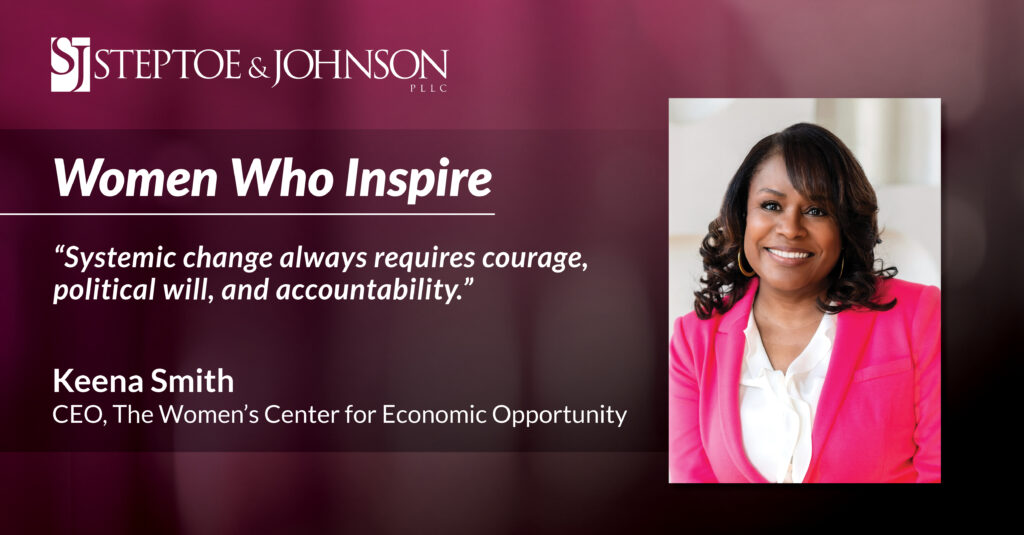
Keena M. Smith is an award-winning economic strategist who founded The Women’s Center for Economic Opportunity (WCEO) in 2013 and became its CEO in 2021. Prior to the WCEO, Keena served for more than 25 years in local government and economic development positions, including with the city of Columbus and the Franklin County Board of Commissioners, where she was appointed the first African American woman deputy county administrator.
The WCEO equips and empowers socially and economically disadvantaged entrepreneurs in five areas: wellness, business and wealth acceleration, research, publishing, and ecosystem building. In May 2025, Keena became the founding publisher of Aspire Women’s Book of Business, which elevates the visibility of the economic impact of women in entrepreneurship.
Keena is also a business owner of nearly 30 years, supporting public and private sector organizations with research, planning, and capital-raising strategies to foster shared prosperity in the communities they serve. Through her work nationally and locally, she has helped raise and deploy over $5 billion in New Markets Tax Credits and other capital resources, accessible to under-resourced communities and entrepreneurs.
Keena has served on many boards and committees, including the Mid-Ohio Regional Planning Commission, The Contemporary Theatre of Ohio, and the Community Shelter Board. She currently serves as chair of the Jobs Ohio Small Business Advisory Council and as secretary of the Preston Brown NFL Foundation, and she is a charter member of the Women’s Collective at the Columbus Chamber of Commerce.
By far, my greatest success has been building the WCEO, which supports women-owned businesses that have been historically under-resourced and under-funded. I’m grateful and proud that the economic development and entrepreneurial support work we do isn’t just inspirational; it’s practical. We help women strengthen their mindsets and improve their wellness in combination with helping them grow their businesses and access capital.
The WCEO’s greatest impact is supporting women who are creating jobs, building generational wealth, and expanding opportunities in the communities they live in and love. The research we conduct ensures that programs and initiatives are data informed.
I’ve had experience working in business development and entrepreneurial support, but I am also a 25-year veteran of public service. I always share the same advice with them: Strive for excellence and be intentional. Learn about your industry and learn how power moves in your industry. Here is the key difference maker: You have to learn who makes decisions, who decides how budgets work, and what outcomes get rewarded.
Lean into meaningful relationships, because across the board, relationships are the currency of success. Position yourself as a person who can deliver on aligned outcomes consistently, and do not confuse proximity with progress. Seek mentors and prioritize sponsors, because these are the people who are going to say your name in rooms that you’re not in and help you get into those rooms yourself.
Another piece of advice is ownership: Own your business, your intellectual property, your data, and your voice in the market. Ownership also means owning a seat at the table. In central Ohio, women make up a slight majority of the population. We should see that reflected more in positions of influence and in the locus of power, because that power impacts our everyday lives and our ability to earn and build wealth in our community.
Lastly, I would share that as women we can’t be afraid to move on when there’s evidence that we are being tolerated instead of appreciated and celebrated for the value that we add with our excellence and hard work. It comes down to trusting yourself. One of my favorite quotes is by Audre Lord. She said, “When I dare to be powerful, to use my strength in the service of my vision, then it becomes less and less important whether I am afraid.”
It’s a stubborn issue, and it shows up in both corporate careers and business ownership. The fix is not complicated — but it’s not easy, because it is going to take systemic change, and systemic change always requires courage, political will, and accountability.
Consistent awareness and monitoring of contracts to make sure there’s equity can help. More important is for an organization to adopt intentional strategies with measurable outcomes and implement tools that promote pay transparency. We don’t have those regulations now, but there are some corporations and organizations that are going above and beyond, and we need to follow in their footsteps.
Beyond the dollars, I think it’s important to talk about access. Equity isn’t only equal pay for equal work; it’s equal opportunity. Get in the network to get a voice, to get the work, to get the pay.
One critical step is honing our negotiation skills. I wish I had learned that earlier in my career. Negotiation can make for uncomfortable conversations. It feels very risky, but that’s intentional. The system wants us to feel at risk when we’re leaning into our value, when we come with the data, the metrics, the market comparisons, and the documented achievements. Taking a negotiation class or course can be incredibly impactful. I’ve done it myself, and it made a meaningful difference in my career.
There is power in being willing to put your value on the table while remaining detached from the outcome. You hope for the best, but you are prepared to walk away if necessary. That willingness is powerful. Many women struggle because we can become deeply attached to outcomes, and that attachment can limit us. Creating space to step fully into our power during negotiations can be powerful in both our careers and our businesses.
My mother is at the top of the list. She’s in her 80s and fiercely independent — and I want to be just like her.
I’m also inspired by my daughter, who became the first female physician in our family just a few weeks after her brother became the first physician in our family. We are truly blessed. My sister also made history as the first woman to become an NFL agent representing her own son, which is incredibly inspiring.
I’m inspired by innovative women who “build it anyway” — without permission, without perfect conditions, and without shrinking from their visions.
And of course, I am deeply inspired by the exceptional women I work with through the WCEO. These women have built businesses despite being under-funded and under-resourced. They include solopreneurs, brick-and-mortar business owners, attorneys, doctors, and other professionals. At the WCEO, we call them exceptional women who bet on themselves. They often don’t receive the recognition they deserve, but they continue to push forward, and that inspires me every day.
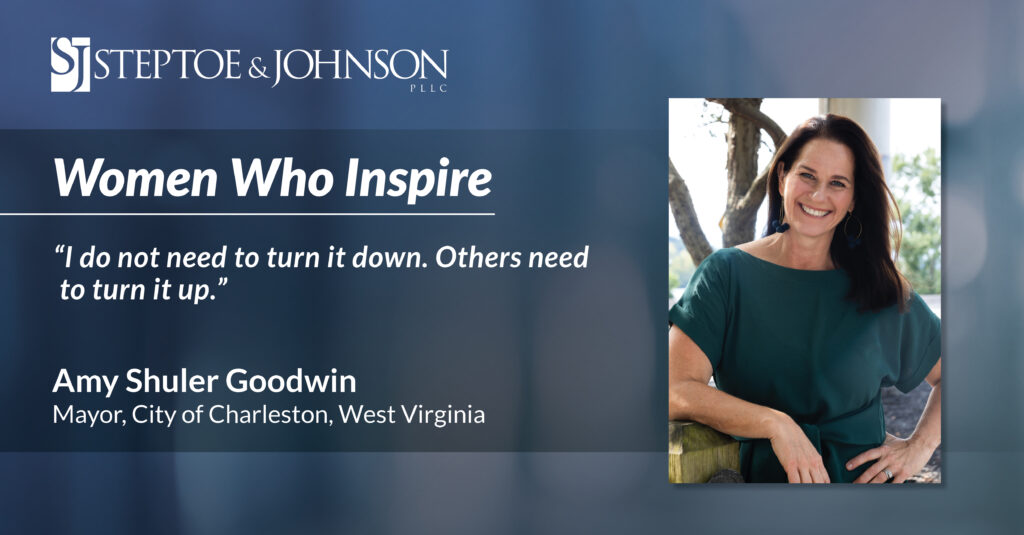
Amy Shuler Goodwin was elected as the first female mayor of Charleston, West Virginia, in 2018 and re-elected in 2022. Since taking office, she has focused on fiscal accountability, transparent government, and people-centered solutions — priorities that have guided Charleston through growth, challenges, and opportunities.
Under Mayor Goodwin’s leadership, the city has advanced major investments that strengthen public safety, infrastructure, and quality of life, including a $20 million Public Safety Center, $5 million in fire station renovations, expanded road repairs, and the $25 million Capital Connector Project which improves riverfront access and connectivity. She has also emphasized neighborhood-focused initiatives and community partnerships that support engagement and long-term stability, while helping create conditions that have supported more than $315 million in private investment citywide.
Mayor Goodwin has championed innovative approaches to complex challenges. She established the Coordinated Addiction Response Effort (CARE) to address substance use disorder, later expanding the program to include mental health and homelessness services. Her tenure has included significant investments in parks and recreation, the return of the Charleston Sternwheel Regatta, which generated more than $40 million in economic impact, and the continued recruitment of sports tourism events that support local businesses and jobs.
Mayor Goodwin serves as First Vice President of the National League of Cities’ Women in Municipal Government and as President of the West Virginia Municipal League. Her leadership and service have been recognized by Alpha Xi Delta with the 2025 Women of Distinction Award and by the West Virginia Municipal League with the Lydia Main Breaking Boundaries Award. She was also recognized as one of the YWCA Charleston’s Women of Achievement, acknowledging her personal and professional commitment to her community.
The answer people often expect, and the easiest one to give, is becoming the first female mayor of the capital city of West Virginia. I am incredibly proud of that accomplishment.
I am proud to have pushed open a door that was already cracked and to have become Charleston’s first female mayor. But as I have grown older, I have realized that my greatest success is not something that appears on a resume or in a headline.
I believe my greatest accomplishment is becoming comfortable with taking chances and navigating uncertainty. Leadership means making decisions even when you are not entirely sure of the outcome. Learning to make difficult decisions quickly, balancing both head and heart, has been one of the most important achievements of my career.
One of the biggest challenges I still see today is that I am often the only woman in the room, particularly when discussing policy, politics, and municipal government. I travel across the country meeting with municipal leaders, and most of those rooms are still predominantly male.
For young women who want to build successful careers, I encourage them to become actively engaged in civic life. Join boards and commissions. Pay attention to what is happening in your community. Whether someone wants to be a mayor, a marketing professional, a lawyer, or a judge, understanding the broader world around them is essential.
One of the best pieces of advice I ever received came from Dr. Christine Martin at West Virginia University during my freshman year. She told us that one of the most valuable things we could do, both professionally and personally, would be to understand what was happening in the world around us. At the time, we were given free subscriptions to Time magazine. We were expected to read it every week so we could stay informed and develop a broader perspective.
Today I would give similar advice to young women entering the workforce: Develop a strong understanding of your local community. Know what conversations are shaping it. Follow credible news sources. Pay attention to what is happening around you.
When I first became mayor, several experienced leaders told me I needed to “turn it down.” Even my children jokingly call me “extra.” For a while, I tried to follow that advice and rein it in. But over time, I realized something important: I do not need to change who I am to make others comfortable.
Not everyone has to like my personality or my leadership style. At the recent YWCA Women of Achievement event, I said something that reflects how I feel today: I do not need to turn it down. Others need to turn it up.
What people see outwardly does not always reflect what is happening internally. There are days when this work is exhausting, and leadership often brings doubt and pressure. But I gain energy from being around people, that is simply part of who I am.
I currently serve on 26 boards and commissions, and as mayor I appoint members to 28 boards. When I took office, we made a deliberate effort to ensure those boards reflected the diversity of our community. Today Charleston has the most diverse boards and city council in its history.
Supporting women is not only about promoting organizations that already exist. It is about creating opportunities and ensuring women have seats at decision-making tables. Sometimes empowerment comes from places people do not immediately recognize, like an arts commission. When strong women who care deeply about arts, history, and culture are appointed to those boards, they are shaping the future of their community.
I lead an organization of 750 employees with a $113 million budget, and I have only been doing so for seven years. I learn something new every day. Leadership is a process of trying things, making mistakes, and adjusting.
One of the biggest failures in leadership, especially when advancing women into leadership roles, is failing to hold everyone accountable. Accountability matters. I expect the people around me to be accountable, and I expect them to hold me accountable as well.
We often talk about building leadership pipelines, mentorship programs, and training opportunities. Those things are incredibly important. But if someone reaches a senior leadership role and discovers there is no accountability or oversight, the culture will not support sustainable leadership. Without accountability, none of those other efforts will succeed.
The women who inspire me are not always those serving on major boards or commissions. Sometimes it is the single mother juggling work, children, schoolwork, and household responsibilities without much support. She is trying to pay her bills and keep everything together. Quite honestly, I am often more inspired by what she accomplishes in a single day than by many of the meetings I attend.
There is one person who has influenced me every single day since the moment I was born: my sister. She is the voice in my head and the last person I call most nights when I am driving home. Sometimes she fills me up with laughter after a long day; other times I share something that happened and she helps me think it through.
Everyone needs someone like that, someone who will always take the call, who will be honest, and who will walk through life’s challenges with you.
We live in a world where people are incredibly busy and often overwhelmed. What we often lack is genuine connection and support. Finding that person, whether it is a sibling, a friend, or someone you meet at a conference, can make all the difference. Go find that person. Make that your goal.
Absolutely. Put your name on the ballot. Put yourself forward.
Too many people believe the only way to make a difference is by serving as a governor, a member of Congress, or a West Virginia senator or delegate. That is not the only path, and often it is not the most effective one. Real change often begins locally.
People sometimes ask what job best prepared me to become mayor. They assume it was working for Hillary Clinton or John Kerry during their presidential campaigns, or serving in the governor’s office, or working as a television reporter and anchor. But the job that prepared me most was being a waitress. That experience taught me more about leadership than any title ever could. It required constant movement, attention to detail, multitasking, and serving people with professionalism, no matter what the day looked like.
At its core, leadership is service. If someone believes public service is their calling, I often tell them to spend time working in the service industry. That experience will teach you more about leadership and humility than any titled position ever will.
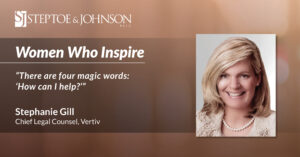
Views expressed in the following interview with Stephanie Gill do not necessarily represent the views of Vertiv.
Stephanie Gill is Chief Legal Counsel for Vertiv. Her responsibilities include global legal strategy; corporate compliance; and responsible business and environmental, health, and safety functions.
Prior to joining Vertiv, Stephanie served as Vice President, General Counsel, and Corporate Secretary of a publicly traded exploration and production company. Early in her career, she worked for national law firms and practiced in the telecommunications, health care, oil and gas, and real estate development industries.
Her practice focused primarily on mergers and acquisitions and corporate finance transactions. While in law school, Stephanie served as a law clerk to the Honorable Judith Fitzgerald of the United States Bankruptcy Court for the Western District of Pennsylvania.
Stephanie is a magna cum laude graduate of The Wharton School of the University of Pennsylvania, with a Bachelor of Science degree in economics and a concentration in accounting. She also graduated magna cum laude from Penn State Dickinson Law, where she was the managing editor of The Law Review and a member of the Woolsack Honor Society. She and her husband have three children and enjoy traveling and exploring the outdoors.
First and foremost, any success I could mention is a shared success. For me, it’s all about the team and team dynamics, and that’s not only with respect to my family, but also here at Vertiv. It’s with the company family, and, of course, outside counsel like Steptoe & Johnson, but also with my family at home, because I couldn’t do what I do without their support. It’s a collective effort in terms of thinking about my career and any success I could mention. It’s all about teamwork.
I have four pieces of advice.
First, there are four magic words: “How can I help?” I was taught that back in the day; you should go to your colleagues, go to your partners, go to your internal customers and just say, “How can I help?”
Second, be brave, jump in, and operate outside your comfort zone, daily if you can. Operate in those shades of gray, because that’s where you learn the most. If you keep doing what you’re always comfortable with, the learning isn’t as incremental or as quick as it is when you’re trying something new.
Third, find a mentor who will show you the ropes — someone who will say your name in rooms when you’re not there and doesn’t worry about compensation or credit.
Fourth, enjoy the adventure. Because, whether you’re practicing law or engaging in some other professional endeavor, this is fun (or it’s supposed to be fun). It has its challenges, but you need to understand that it’s about the journey, not the destination. So enjoy it.
I’m a consistent supporter of women’s professional development within their organizations, but for me, with respect to the legal community, I think the best value is the one-on-one mentoring. I benefit greatly from my mentors, so I try to pay that same mentoring forward to anybody who wants to be mentored. To me, that is the most powerful way in which we can empower women to be successful.
Right now, sitting here in 2026, it’s about artificial intelligence. It’s about getting out there, getting your arms around it, figuring out how to leverage efficiencies, and determining how to ensure our customers and clients are being serviced quickly and more accurately with respect to the information that we provide. If women in the workspace can figure out how to leverage those opportunities, I think they’ll find themselves at a competitive advantage relative to their positioning in the workforce.
If women can jump in, be brave, and just start experimenting, regardless of where they are in their careers, that’s what’s going to be a real differentiator.
There are countless women who’ve inspired me, including Sharon Flanery (Steptoe & Johnson’s Department Chair Emeritus of the Energy and Natural Resources department). From the day I met her, it was clear that she is everywhere and everything to everyone. She also has a full life outside of work. She has a husband and a daughter, and what she has accomplished over the course of her career, and continues to achieve, is incredibly impressive.
What stands out to me most is that she remembers people. She knows what makes them tick, and she is always sincere. No matter what’s going on in her own life, she takes the time to think of others.
My mom is also someone who inspires me. She was a teacher and a small-business owner who helped my dad operate car washes. When she was 49, she had a devastating stroke that left her with many physical challenges, which are still present, but from that day forward, she’s always persevered. She wakes up every morning and looks at the day as an opportunity. Her resilience and willingness to be optimistic in the face of difficult circumstances have been very inspirational to me. She has been a grounding presence for me, and a lot of good things have come from that.
There are a couple of things that came to mind.
First, identify high-potential women early. Identify them early and rotate them to give them as much experience as possible. Put their name in the hat when it comes to succession planning. I know companies often ask, “Who’s ready for this role two to three years out?” I would encourage us to also think about five, 10, and 15-to-20 years out. Those junior professionals who are superstars today will likely be superstars down the line. Let’s get them in that pipeline early and keep them on the succession planning list.
Second, mentor, mentor, mentor. Show them the art of the possible so that they don’t lose their way. I think many of us have had the same experience, starting out in a class with a lot of talented women, and as the years progressed, fewer and fewer of them remain. There are a number of reasons for that, but I do think mentorship plays a role. If they can see someone who has a family and is also thriving at the highest levels of an organization, if they can see that example up close and interact with that person regularly, it provides a road map. It makes those leadership roles feel attainable.
For someone to be successful, they need the smarts and the ambition, but that alone can’t make them successful. They need someone who’s going to be in their corner. Without someone who will advocate for them and help push them forward, it’s very difficult to reach the C-suite. Most successful leaders didn’t get there on their own; they had a support system.
First and foremost, you care about your clients, and you have, in particular, cared about your female clients. Steptoe & Johnson distinguishes itself by sitting down face-to-face and reviewing their performance with their clients. They simply ask, “Hey, tell me how the last year went? Tell me how the deal went?” That’s huge.
You also put resources behind women-centered forums. An organization that supports women, like Steptoe & Johnson does, says a lot about the firm and the people who work there.
 Sponsored Event Sponsored Event Sponsored Event Sponsored Event
Copyright © 2026 Steptoe & Johnson PLLC. All rights reserved. Disclaimer